




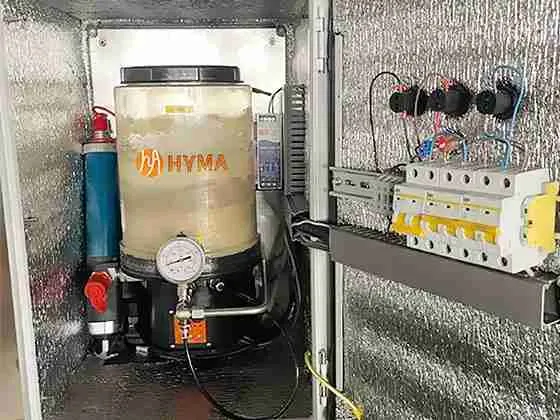
The central lubrication system is a system that transfers lubricating oil or grease to various parts of the machine through central oil supply equipment, pipelines, pump stations and other equipment for lubrication.
The central lubrication system can control the supply amount and time of lubricant to ensure that the lubricant reaches all parts of the machine at the appropriate time and amount, thereby achieving good lubrication of the machine.
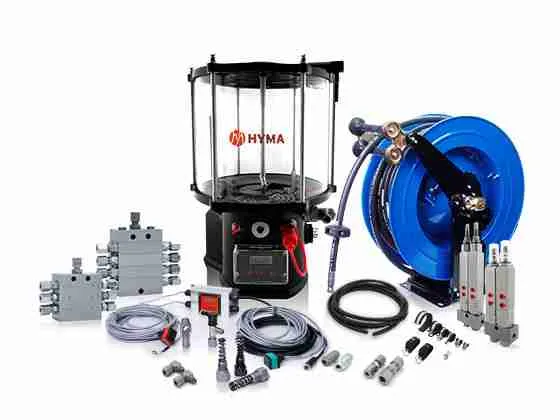
HYMA Central Lubrication System composed of high quality components to ensure you can easily operate the related lubrication equipment. We also provide custom solutions to save your time on different lubrication system spare parts.
The central lubrication system line addresses universal pain points. Smart diagnostics integrated into every centralized lube system enable predictive maintenance—clients receive alerts before issues escalate, transforming your offerings from “products” to “profit-protecting partnerships.” With 30% faster grease distribution compared to manual methods, end-users report fewer unplanned shutdowns and extended machinery lifecycles, directly boosting customer retention for your business.
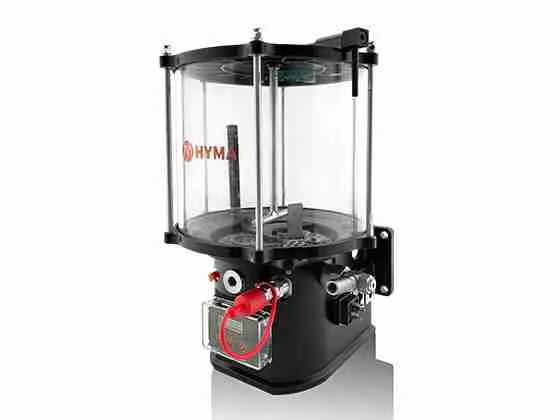
You can use our lubrication pump to deliver sufficient amount of lubricating grease to your machine parts.
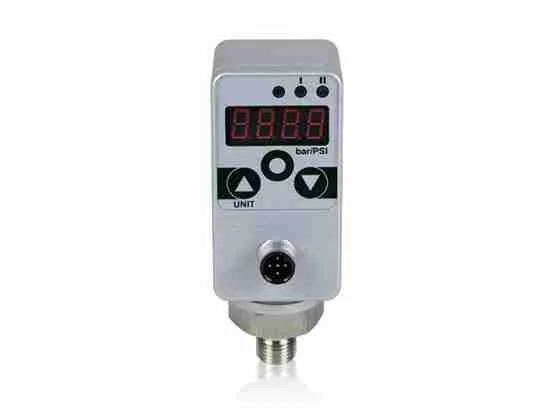
You can monitor the grease pressure of the lubrication system with HYMA oil pressure sensor

You can protect your machine engines with our pressure regulating valve.

The grease cooler lowers the evaporation temperature by circulating coolant to reach appropriate temperature range.

The nozzle is responsible for spraying the lubricating oil to various parts of your machine.

You can use it to filter out impurities in the engine oil to prevent these impurities from entering the oil pump.

You can use the grease radiator helps dissipate heat, prevents the oil from overheating

We also supply more accessories at cheap factory price to support your central grease system.
When machinery survival hinges on precision grease delivery, HYMA’s central lubrication system applications deliver. From salt-sprayed marine engines to dust-choked mining drills, our systems pump reliability into every cycle, slashing unplanned downtime by up to 50%. No more guesswork—HYMA’s rugged centralized grease lubrication systems auto-adjust to load shifts, temperature swings, and 24/7 operation, keeping conveyors, presses, and offshore rigs running smoother, longer.
As one of centralized lubrication system manufacturers, we build for realities: corrosion-resistant housings, error-proof diagnostics, and whisper-quiet pumps that outlast competitors. Distributors gain a loyalty-driving edge—HYMA tech doesn’t just lubricate; it prints profit by protecting your clients’ bottom lines.
Grease or lubricating oil is extracted and transported to various lubrication points through a central lubrication pump to lubricate various parts of the machine.
The central lubrication system can control the supply amount and time of the lubricant to ensure that the lubricant reaches various parts of the machine at the appropriate time and amount, thereby achieving good lubrication of the machine.
In a centralized lubrication system, the workflow can be summarized as follows:
1. The pumping equipment extracts lubricant from the lubricant storage device and delivers it to the distributor through the connecting pipe.
2. The distributor distributes the lubricant to each component that needs lubrication according to the preset program or the sensor signal. This process can be timed or adjusted in real time according to the working status of the component.
3. The control device monitors the entire lubrication process in real time to ensure that each lubrication point can get enough lubricant. At the same time, the control device can also adjust the pumping equipment and distributor according to the operating status of the equipment and the consumption of lubricant to achieve the best lubrication effect.
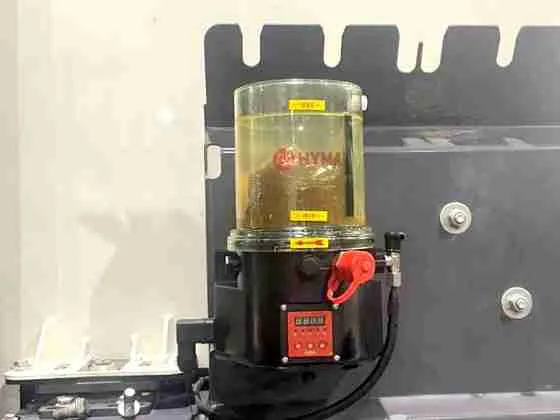
Your Equipment conditions: First, you need to choose a suitable lubrication system according to the working environment and conditions of your mechanical equipment. You might need to choose larger type of central lubrication system if there’re more machines need to be lubricated.
Type of central lubrication system: Common types of central lubrication systems include single-line damping lubrication system, volumetric lubrication system, progressive lubrication system, dual-line lubrication system, oil mist cooling lubrication system, oil-gas lubrication system and single-point lubrication system. You need to confirm your lubrication need with specific applications.
Performance parameters: It is best if you can find your machine working specification to match with the central lubrication system so it can provide sufficient oil volume. The system should have high working reliability, adopt effective sealing and filtering devices, keep the lubricant clean, and prevent external dust and moisture from entering the system.
Maintenance cost: You can save cost to use a simple structure central lubrication system, however, it is recommend to choose a reasonable central lubrication system for your actual situation.
The price factors of the central lubrication system mainly include the following aspects:
Equipment differences: You have to pay more for the heavy equipment central lubrication system as it require more complex lubrication systems to ensure the long-term stable operation, while light equipment has relatively low grease requirements. This equipment difference makes the design and configuration of lubrication systems different and affects their prices.
Lubricant requirements: The lubricants is different based on the various working conditions and this can affect the cost of your central lubrication system. High grade lubricants are usually more expensive than ordinary lubricants and you need to choose the right lubricants or grease before buying the central grease system.
lubrication system configuration: The configuration of your central lubrication system will also decide your cost. You will spend more money getting advanced central lube system compared to the ordinary grade type.

For distributors seeking reliable, high-margin industrial partners, our expertise as centralized lubrication system manufacturers delivers cutting-edge technology tailored to global market demands. Specializing in central lube systems, we engineer solutions that simplify maintenance, slash operational costs, and strengthen your competitive edge.
Our central grease systems are precision-built for durability. Utilizing proprietary manufacturing processes and aerospace-grade materials, each unit withstands relentless industrial cycles—from agribusiness harvesters to offshore drilling rigs. Unlike generic alternatives, our centralized grease lubrication systems feature adaptive pressure controls and fail-safe valves, minimizing installation complexities for your clients. Distributors benefit from streamlined logistics: standardized components reduce lead times, while modular designs allow quick customization for niche sectors like food-grade facilities or desert mining operations.
When your operations demand precision and longevity, HYMA delivers unmatched reliability as a trusted centralized grease lubrication system manufacturer. Our central lube system solutions are engineered to optimize equipment performance while minimizing maintenance downtime. You’ll experience consistent lubrication coverage across all critical points with our centralized lubrication system, designed for heavy-duty industrial applications.
The HYMA centralized grease system stands out with durable components that withstand harsh environments, ensuring your machinery runs smoother for longer. Whether you’re a distributor seeking quality inventory or an end-user requiring high-volume solutions, our centralised grease lubrication system adapts to your specific needs. Every unit undergoes rigorous testing because your productivity depends on flawless performance.
Choose HYMA’s central lubrication system for efficiency you can measure and durability you can trust. Let’s keep your machines running at peak condition—contact us today to discuss tailored solutions.
HYMA is your reliable Central Lubrication System Manufacturer with complete development ability to help you make better lubrication. Our 200+ workers and 60+ engineers are available to produce qualified lubrication equipment and greasing system to meet your machinery maintenance need.
There are over thousands of lubrication system suppliers in the market and HYMA stands out with custom solution and ODM service for distributors and brand manufactuers across the world.
We empower distributors with more than hardware. Backed by 24/7 technical support, certified training programs, and white-label marketing kits, our collaboration ensures you dominate markets hungry for efficient lubrication tech. From compact central grease systems for urban manufacturing plants to heavy-duty configurations for pulp mills, our scalable solutions cater to evolving industry regulations and sustainability goals.
Capitalize on the shift toward automated industrial maintenance. Partner with a manufacturer that equips you to win bids, satisfy specs, and exceed ROI expectations. Let’s redefine reliability—one grease cycle at a time.
A central lubrication system is an automated network that delivers precise amounts of lubricant to multiple points on a machine from a single source. Unlike manual greasing, which relies on a technician with a grease gun, this system operates while the machine is running, ensuring a “small amount, frequent interval” approach.
For beginners, the difference is night and day. Manual greasing often leads to a “feast or famine” cycle: bearings are over-lubricated once a week (causing heat and seal damage) and then run bone-dry by day six. A central lubrication system eliminates human error and safety risks associated with climbing into dangerous or hard-to-reach areas of a machine. From a distributor’s perspective, selling this system isn’t just selling hardware; it’s selling a “set-and-forget” insurance policy for expensive industrial assets. While manual labor is prone to skipping hidden lubrication points, an automated system ensures 100% coverage, significantly extending the mean time between failures (MTBF).
Installation involves mounting the pump, running main lines to distribution blocks, and connecting secondary lines to individual points. While complex, modern “plug-and-play” kits make it possible for beginners to DIY the setup by following a schematic.
To successfully install a central lubrication system, one must first map out all lubrication points. Start by mounting the electric or pneumatic pump in an accessible location for easy refilling. The “backbone” of the system consists of high-pressure hoses or steel pipes leading to metering valves (dividers). For beginners, the biggest challenge is air entrapment; you must prime the pump and lines before final connection. Distributors often provide pre-assembled manifolds to simplify this for their clients. If you are replacing a SKF system with a Chinese alternative, ensure the mounting holes match or use an adapter plate. Proper routing is crucial—avoid sharp bends and keep lines away from heat sources or moving parts that could pinch the tubing.
The primary components include the lubricant reservoir, the pump element, the controller (timer), the distribution valves (metering devices), and the pressure monitoring sensors.
Regular maintenance of a central lubrication system focuses on cleanliness. The most common cause of failure is contamination. Beginners must ensure that the grease used to refill the reservoir is filtered and that the reservoir lid is never left open. Distributors should advise clients to check the pressure gauge weekly; a sudden drop indicates a leak, while a spike indicates a blockage in a distribution valve. The suction filter inside the pump should be cleaned or replaced annually. In Chinese “replacement” models, these components are often modular, allowing you to swap a single pump element without replacing the entire unit, which is a significant cost advantage over some integrated European designs.
Selection is based on the total volume of lubricant required per cycle, the distance to the furthest point, and the operating environment.
When selecting a pump for a central lubrication system, you must calculate the “total displacement.” Each lubrication point requires a specific volume (e.g., 0.2cc). If you have 20 points, you need at least 4cc per cycle. You must also consider the reservoir size; a 2L reservoir might suffice for a small CNC machine, but a 20L drum pump is needed for a heavy excavator. For distributors looking for Chinese alternatives, check the “max pressure” rating. If your system has long pipe runs (over 20 meters), you need a high-pressure pump (up to 30MPa) to overcome line resistance. Chinese manufacturers often offer more customization in motor voltage (DC24V vs AC220V), making it easier to match the pump to the machine’s existing power supply.
Most systems are designed specifically for either oil or grease. While some pumps are “multi-media,” the internal seals and the design of the distribution valves usually differ significantly between the two.
An oil-based central lubrication system typically uses gear pumps and is common in high-speed spindles or textile machinery where cooling is as important as lubrication. Grease systems, however, use piston pumps to handle thicker NLGI #2 grease. Beginners should never swap media without consulting the manual; putting grease in an oil pump will burn out the motor, while oil in a grease pump will likely leak past the seals. Distributors should note that Chinese “flat replacement” systems often use higher-quality Fluorine rubber seals as standard, which allows them to handle a wider range of synthetic lubricants compared to the basic NBR seals found in some entry-level Western models.
High-end Chinese systems now rival the “Tier 1” brands in durability and precision, often using the same materials (like 6061 aluminum or hardened steel) but at a lower price point due to vertical integration.
Distributors often worry that a “budget” central lubrication system means plastic parts. In reality, the top Chinese manufacturers have spent the last decade as OEM suppliers for global brands. Their own-brand systems use CNC-machined components and standardized O-rings. The “feel” of a Chinese pump might be slightly more utilitarian, but the internal tolerances in the piston-and-bore assemblies are often identical to SKF. The main difference lies in the “brand premium.” By choosing a reputable Chinese central lubrication system, a distributor can offer a product that performs at 95% of the capacity of a Lincoln system for 50% of the cost, making it the perfect “平替” (affordable alternative) for the current market.
For a distributor, picking the wrong partner is expensive. Beyond just looking at photos, ask for a video of their testing lab. A reliable central lubrication system manufacturer will have a dedicated station where they test every pump for pressure retention and leak-back before shipping. Check if they use reputable electronics for the controllers—standardized PLC components are better than “black box” proprietary boards. Beginners should look for manufacturers that provide clear English manuals and video tutorials. A company that invests in high-quality documentation is usually a company that invests in the quality of its central lubrication system hardware.
Many high-tier Chinese models now include these as “standard” to compete with Western brands, whereas others offer them as modular add-ons.
Safety and monitoring are paramount. A central lubrication system without a low-level switch is a risk; if the grease runs out, the machine fails. Most “export version” Chinese pumps include a magnetic float switch in the reservoir and a pressure switch at the pump outlet. For distributors, this makes the product an “easy sell” because it offers the same safety features as a premium SKF unit. Beginners should always opt for the version with these sensors; the extra $50 spent on a “smart” central lubrication system pump can save a $50,000 machine from a catastrophic seizure.
The primary saving is in the “Initial Purchase Price” and the “Cost of Replacement Parts,” which can be 50-70% lower than Tier 1 brands.
When evaluating a central lubrication system, look at the Total Cost of Ownership (TCO). A premium brand pump might cost $3,000, with replacement elements costing $400 each. A Chinese “alternative” pump might cost $1,200, with elements costing $60. Over five years, the Chinese central lubrication system saves thousands of dollars in maintenance overhead. For a distributor, this allows you to capture the “value segment” of the market—customers who need reliability but cannot justify the “brand tax” of a global conglomerate. As long as the system is maintained (clean grease, regular filter checks), the performance gap is negligible, making the Chinese central lubrication system the smartest choice for modern industrial maintenance.
Yes, industry-specific kits are a major growth area, featuring stainless steel for food grade or heavy-duty shrouding for mining.
The “one size fits all” approach is dead. Distributors should look for Chinese partners that offer specialized central lubrication system kits. For example, a food-grade kit will use food-safe lubricants and 316 stainless steel fittings to resist corrosion during washdowns. A mining kit will feature a high-protection (IP65) rated controller to withstand dust and vibration. For the beginner, these kits are a lifesaver because they include all the necessary mounting brackets and pre-filled lines, turning a complex engineering task into a simple “bolt-on” afternoon project. A specialized central lubrication system adds immense value and allows distributors to target niche markets with higher margins.